What Three Elements or Principles Are in the Art Piece a Mesopotamian Votive Dog Statuette
The art of Mesopotamia has survived in the archaeological record from early hunter-gatherer societies (8th millennium BC) on to the Bronze Age cultures of the Sumerian, Akkadian, Babylonian and Assyrian empires. These empires were later replaced in the Iron Age by the Neo-Assyrian and Neo-Babylonian empires. Widely considered to be the cradle of civilization, Mesopotamia brought significant cultural developments, including the oldest examples of writing.
The art of Mesopotamia rivalled that of Ancient Egypt as the most thou, sophisticated and elaborate in western Eurasia from the 4th millennium BC until the Persian Achaemenid Empire conquered the region in the 6th century BC. The chief emphasis was on various, very durable, forms of sculpture in stone and clay; picayune painting has survived, just what has suggests that, with some exceptions,[1] painting was mainly used for geometrical and plant-based decorative schemes, though most sculptures were too painted. Cylinder seals have survived in large numbers, many including complex and detailed scenes despite their small size.
Mesopotamian art survives in a number of forms: cylinder seals, relatively pocket-size figures in the circular, and reliefs of various sizes, including cheap plaques of moulded pottery for the habitation, some religious and some apparently not.[2] Favourite subjects include deities, alone or with worshippers, and animals in several types of scenes: repeated in rows, single, fighting each other or a human, confronted animals by themselves or flanking a human or god in the Master of Animals motif, or a Tree of Life.[3]
Stone stelae, votive offerings, or ones probably commemorating victories and showing feasts, are also found from temples, which unlike more official ones lack inscriptions that would explicate them;[4] the fragmentary Stele of the Vultures is an early example of the inscribed type,[v] and the Assyrian Black Obelisk of Shalmaneser Three a large and well preserved late one.[6]
Prehistoric Mesopotamia [edit]

Area of the Fertile Crescent, (c. 7500 BC), with main Pre-Pottery Neolithic menses sites. The north and northwest of Mesopotamia were already settled past humans; the center and south, with insufficient natural rainfall, were not.
The highland regions of Mesopotamia were occupied since the Neanderthal times, for example at the site of Shanidar Cavern (65,000–35,000 years ago), but with no known artistic creation.[7] [8] The showtime artistic productions of Mesopotamia appear in the surface area of Upper Mesopotamia simply, at the end of the Neolithic during the Pre-Pottery Neolithic A menstruum, with simple representations of humans and animals as well as megaliths (9,500–eight,000 BC). This succeeds an before period of evolution in the Levant, as in the Hayonim Cave, were carvings of animals such equally horses are known from the earliest dates of the Upper Paleolithic, with dates ranging from xl,000 to 18,500 BP.[9] [x] [xi] [12]
In Prehistoric and Ancient Mesopotamia, the climate was cooler than in Egypt or the Indus Valley, meaning that the valleys of the Tigris and Euphrates rivers were very dissimilar from the deserts of today; in the highlands there were bands of forest interspersed with steppes and savannas rich in flora and abounding with goats, boars, deers, and fob. Later the invention of agriculture, farmers worked in the valley, simply the community lived in the more easily fortifiable hills. Unlike in China and the Indus Valley Civilization, the villages had two economic orientations, downhill to the fields of grain and uphill into the mountains of Anatolia with their rich mines of gold and copper. Mesopotamian cultures were thus continually in a state of flux, which had its own advantages and difficulties.
Art of the Pre-Pottery Neolithic menstruation (circa 9000–7000 BC) [edit]
Pre-Pottery Neolithic A [edit]
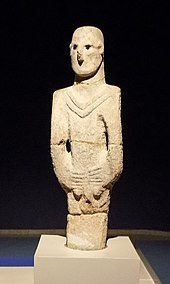
Following the Epipalaeolithic period in the Almost East, several Pre-Pottery Neolithic A sites are known from the areas of Upper Mesopotamia and the northern mountainous fringes of Mesopotamia, marked by the advent around 9000 BC on the banks of the Upper Euphrates of the world's oldest known megaliths at Göbekli Tepe,[16] and the beginning known use of agronomics around the same time at Tell Abu Hureyra, a site from the preceding Natufian civilisation.[17]
Numerous realistic reliefs and a few sculptures of animals, also as fragments of reliefs of humans or deities, are known from Göbekli Tepe and dated to circa 9000 BC. The Urfa Human found in another site nearby is dated to the period of the Pre-Pottery Neolithic circa 9000 BC, and is considered as "the oldest naturalistic life-sized sculpture of a human being".[13] [xiv] [xv] Slightly later, early homo statuettes in stone and fired clay accept been found in other Upper Mesopotamia sites such every bit Mureybet, dated to 8500–8000 BC.[18] [19]
Pre-Pottery Neolithic B [edit]
Around 8000 BC, during the following period of Pre-Pottery Neolithic B, however earlier the invention of pottery, several early settlements became experts in crafting beautiful and highly sophisticated containers from stone, using materials such as alabaster or granite, and employing sand to shape and polish. Artisans used the veins in the material to maximum visual effect. Such object take been plant in abundance on the upper Euphrates river, in what is today eastern Syria, specially at the site of Bouqras.[20]
In northeastern Mesopotamia, the Jarmo civilization (7500 BC), centered on the site of Jarmo (Qal'at Jarmo) is a prehistoric archeological site located in modern Iraq on the foothills of the Zagros Mountains. Excavations revealed that Jarmo was an agricultural community, dating back to 7500 BC, based on irrigation through natural rainfall. It preceded the homo expansion towards the alluvial plains of central Mesopotamia. Information technology was broadly gimmicky with such other important Neolithic sites such as Jericho in the southern Levant, Çatal Hüyük in Anatolia or Tell Sabi Abyad in northern Syria. Some fragments of stone vessels and alabaster jars accept likewise been found in Jarmo, dating to circa 7500 BC, before the c.7000 BC invention of pottery.[21] [22] [23]
-
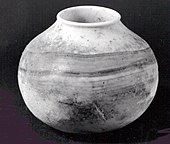
Jar in calcite alabaster, Syria, late 8th millennium BC.
-
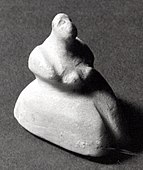
Female statuette, eighth millennium BC, Syria.
-

Alabaster pot Mid-Euphrates region, 6500 BC, Louvre Museum
-
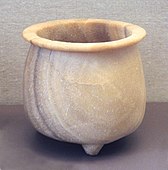
Calcite tripod vase, mid-Euphrates, probably from Tell Buqras, 6000 BC, Louvre Museum AO 31551.[24]
First experiments with pottery (circa 7000 BC) [edit]

The northern Mesopotamian sites of Tell Hassuna and Jarmo are some of the oldest sites in the Near-East where pottery has been institute, appearing in the near recent levels of excavation, which dates it to the 7th millennium BC.[21] This pottery is handmade, of simple design and with thick sides, and treated with a vegetable solvent.[25] There are clay figures, zoomorphic or anthropomorphic, including figures of meaning women which are taken to be fertility goddesses, like to the Mother Goddess of later Neolithic cultures in the aforementioned region.
Halaf civilisation (6000–5000 BC, Northwestern Mesopotamia) [edit]
Pottery was decorated with abstract geometric patterns and ornaments, especially in the Halaf civilisation, also known for its clay fertility figurines, painted with lines. Clay was all around and the primary material; oft modelled figures were painted with black ornament. Advisedly crafted and dyed pots, especially jugs and bowls, were traded. Equally dyes, iron oxide containing clays were diluted in unlike degrees or various minerals were mixed to produce unlike colours.
The Halaf civilization saw the earliest known advent of stamp seals.[26] They featured essentially geometric patterns.[26]
Female fertility figurines in painted clay, perchance goddesses, also appear in this period, circa 6000–5100 BC.[27]
-

Shard; 5600–5000 BC; painted ceramic; 7.nineteen × 4.xix cm; by Halaf culture
-

Halaf civilisation female figurines, 6000–5100 BC Louvre Museum
-
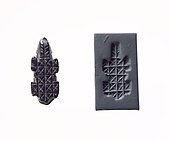
Stamp seal and modern impression- geometric pattern. Halaf culture
Hassuna culture (6000–5000 BC, Northern Mesopotamia) [edit]
The Hassuna culture is a Neolithic archaeological culture in northern Mesopotamia dating to the early sixth millennium BC. It is named after the type site of Tell Hassuna in Republic of iraq. Other sites where Hassuna textile has been found include Tell Shemshara. The decoration of pottery essentially consists in geometrical shapes, and a few ibex designs.
Samarra culture (6000–4800 BC, Central Mesopotamia) [edit]
The Samarra culture is a Chalcolithic archaeological culture in northern Mesopotamia that is roughly dated to 5500–4800 BCE. It partially overlaps with the Hassuna and early Ubaid.
-
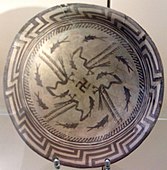
Samarra plate, with a design consists of a rim, a circle of eight fish, and four fish swimming towards the center being defenseless by four birds, at the center beingness a swastika symbol; circa 4000 BC; painted ceramic; diameter: 27.7 cm; Vorderasiatisches Museum (Berlin)
-

Samarra menstruation fine ware, with central Ibex motif; circa 6200–5700 BC; Vorderasiatisches Museum
Ubaid culture (c. 6500–3800 BC, Southern Mesopotamia) [edit]

Northern expansion of the Ubaid civilization after c. 4500 BC
The Ubaid catamenia (c. 6500–3800 BC)[28] is a prehistoric period of Mesopotamia. The name derives from Tell al-'Ubaid in Southern Mesopotamia, where the earliest large digging of Ubaid catamenia material was conducted initially by Henry Hall and later past Leonard Woolley.[29]
In South Mesopotamia the menstruation is the primeval known period on the alluvial apparently although it is likely earlier periods exist obscured under the alluvium.[30] In the due south it has a very long duration between about 6500 and 3800 BC when it is replaced by the Uruk menstruum.[31]
In North Mesopotamia, Ubaid culture expanded during the menstruation between well-nigh 5300 and 4300 BC.[31] It is preceded by the Halaf menstruation and the Halaf-Ubaid Transitional menstruation and succeeded past the Late Chalcolithic flow. The new menses is named Northern Ubaid to distinguish information technology from the proper Ubaid in southern Mesopotamia.[32]
With Ubaid 3 (circa 4500 BC) numerous examples of Ubaid pottery have been found along the Farsi Gulf, every bit far as Dilmun, where Indus Valley Civilization pottery has also been constitute.[33]
Stamps seals beginning to draw animals in stylistic style, and also bear the get-go known delineation of the Principal of Animals at the end of the period, circa 4000 BC.[34] [35] [36]
-
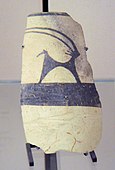
Fragment of pottery with a painting of an Ibex; 4700–4200 BC; painted ceramic; from Girsu; Louvre[37]
-

Lizard-headed nude woman nursing a child, Ur, Ubaid iv period, 4500-4000 BCE, Iraq Museum. "The elongated head, similar to the figures establish at Eridu, could represent an elaborate headdress or possibly cranial binding".[38]
-
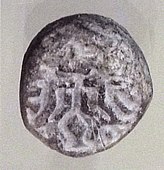
Terracotta stamp seal with Master of Animals motif, Tello, ancient Girsu, End of Ubaid period, Louvre Museum AO14165. circa 4000 BC.[34]
Historic Mesopotamia [edit]
Sumerian period (c. 4000–2270 BC) [edit]
The rise of the non-Semitic-speaking Sumerian culture spans a period of about two millennia, and saw the evolution of sophisticated artistic traditions, as well as the invention of writing, first through pictographic signs, and then through cuneiforms.
Pre-Dynastic menstruum: Uruk (c. 4000 to 3100 BC) [edit]

The historic, proto-literate, menstruation starts with the cultures of the Uruk period (centered on the area in yellow) and Jemdet Nasr period (in brown).
The Protoliterate or Uruk catamenia, named after the city of Uruk in southern Mesopotamia, (ca. 4000 to 3100 BC) existed from the protohistoric Chalcolithic to Early Bronze Age period, following the Ubaid period and succeeded by the Jemdet Nasr menses generally dated to 3100–2900 BC.[39] It saw the emergence of urban life in Mesopotamia, and the ancestry of Sumerian civilization,[xl] and also the first "great creative historic period" of Mesopotamian art.[41] Slightly earlier, the northern city of Tell Brak, today in Syria, besides saw urbanization, and the development of a temple with regional significance. This is called the Heart Temple afterwards the many "center idols", in fact votive offerings, found there, a type distinctive to this site. The rock Tell Brak Head, vii inches high, shows a simplified face; similar heads are in gypsum. These were patently fitted to bodies that have not survived, probably of wood.[42] Similar temples further southward, the Eye Temple was busy with cone mosaics fabricated upwardly of clay cylinders some four inches long, differently coloured to create simple patterns.[43]
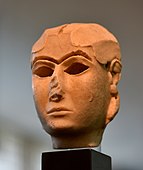
Significant works from the southern cities in Sumer proper are the Warka Vase and Uruk Trough, with complex multi-figured scenes of humans and animals, and the Mask of Warka. This is a more realistic head than the Tell Brak examples, like them fabricated to meridian a wooden body; what survives of this is simply the bones framework, to which coloured inlays, aureate leaf hair, paint and jewellery were added.[44] It could depict a temple goddess. Shells may have served as the whites of the eyes, and the lapis lazuli, a beautiful, blueish semi-precious gemstone, may accept formed the pupils.[45] The Guennol Lioness is an uncommonly powerful pocket-sized figurine of a panthera leo-headed monster,[46] perhaps from the start of the next period.
There are a number of stone or alabaster vessels carved in deep relief, and stone friezes of animals, both designed for temples, where the vessels held offerings. Cylinder seals are already complex and very finely executed and, as later, seem to accept been an influence on larger works. Animals shown are often representations of the gods, another continuing feature of Mesopotamian art.[47] The end of the catamenia, despite being a time of considerable economic expansion, saw a decline in the quality of fine art, maybe as demand outstripped the supply of artists.[48]
-
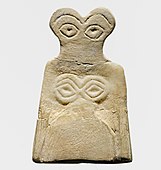
Centre idol; 3700–3500 BC; gypsum alabaster; 6.v × 4.2 × 0.6 cm; Metropolitan Museum of Art
-

Sumerian dignitary, Uruk, circa 3300-3000 BCE. National Museum of Iraq.[49] [l]
-

Cylinder seal impression from Uruk, showing a "male monarch-priest" in brimmed hat and long glaze feeding the herd of goddess Inanna, symbolized past two rams, framed by reed bundles as on the Uruk Vase. Late Uruk period, 3300–3000 BC.[52] [53] A similar king-priest too appears standing on a ship.[54]
-
-
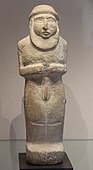
Sculpture of the ritually nude 'Priest-Rex', Late Uruk, Louvre.
-

Tablets with proto-cuneiform pictographic characters, were used for noting commercial transactions (finish of 4th millennium BC), Uruk III.
Early creative exchanges with Egypt (c. 3500–3200 BC) [edit]

Egypt–Mesopotamia relations seem to take developed from the 4th millennium BCE, starting in the Uruk menses for Mesopotamia and the Gerzean culture of pre-literate Prehistoric Egypt (circa 3500–3200 BC).[59] [60] Influences tin be seen in the Pre-Dynastic Fine art of Ancient Arab republic of egypt, in imported products, and also in the possible transfer of writing from Mesopotamia to Arab republic of egypt,[60] and generated "deep-seated" parallels in the early on stages of both cultures.[61]
Distinctly Mesopotamian objects and art forms entered Egypt during this catamenia, indicating exchanges and contacts. The designs that were emulated past Egyptian artists are numerous: the Uruk "priest-king" with his tunique and brimmed hat in the posture of the Master of animals, the serpopards or sepo-felines, winged griffins, snakes around rosettes, boats with high prows, all characteristic of Mesopotamian art of the Belatedly Uruk (Uruk Iv, c. 3350–3200 BC) menstruum.[62] [63] The same "Priest-Rex" in visible in several Mesopotamian works of art of the cease of the Uruk flow, such as the Blau Monuments, cylinder seals and statues.[64]
Pre-Dynastic menstruation: Jemdet Nasr (3100–2900 BC) [edit]
The Jemdet Nasr Period covers the catamenia from 3100–2900 BC. It is named after the blazon site Tell Jemdet Nasr, where the assemblage typical for this menstruum was first recognized. Its geographical distribution is limited to south-central Iraq. The culture of the proto-historical Jemdet Nasr period is a local evolution out of the preceding Uruk period and continues into the Early Dynastic I period. The menses is characterized by splendidly painted monochrome and polychrome pottery, every bit well as the advent of big proto-cuneiform tablets, clearly going beyond the initial pictographic writing.
-

Djemdet Nasr stone bowl, once inlaid with female parent-of-pearl, crimson paste, and bitumen.
-

Cup with Nude Hero, Bulls and Lions, Tell Agrab, Jamdat Nasr to Early on Dynastic period, 3000–2600 BC.
Pre-Dynastic clothes (4000-2700 BC): kilts and "cyberspace-dresses" [edit]
The earliest type of clothes attested in early on Sumerian art is not the kaunakes, just rather a sort of kilt or "net dress" which is quite closely fitting the lower trunk, while the upper body remains bare.[65] This early type of cyberspace wearing apparel looks much more like to standard textile and so the afterward kaunakes, which looks more than like sheepskin with ample bell-shaped volume effectually the waist and the legs.[65] [66]
-

Cylinder seal from Uruk, with "net-apparel", 3100 BC
Early Dynastic period (2900–2350 BC) [edit]
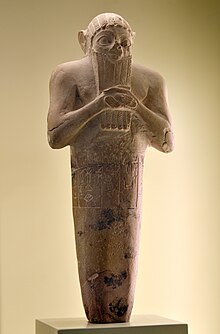
Foundation peg of Lugal-kisal-si, rex of Uruk, circa 2380 BCE. The inscription reads "For (goddess) Namma, wife of (the god) An, Lugalkisalsi, King of Uruk, King of Ur, erected this temple of Namma". Pergamon Museum VA 4855.[67]
The Early Dynastic Period is more often than not dated to 2900–2350 BC. While standing many before trends, its art is marked by an emphasis on figures of worshippers and priests making offerings, and social scenes of worship, war and court life. Copper becomes a significant medium for sculpture, probably despite virtually works having after being recycled for their metallic.[68] Few if whatever copper sculptures are as big as the Tell al-'Ubaid Lintel, which is ii.59 metres wide and 1.07 metres loftier.[69]
Many masterpieces have as well been institute at the Regal Cemetery at Ur (c. 2650 BC), including the two figures of a Ram in a Thicket, the Copper Bull and a balderdash's head on one of the Lyres of Ur.[70] The so-called Standard of Ur, really an inlaid box or fix of panels of uncertain office, is finely inlaid with partly figurative designs.[71]
A grouping of 12 temple statues known equally the Tell Asmar Hoard, at present carve up up, show gods, priests and donor worshippers at different sizes, but all in the aforementioned highly simplified style. All have greatly enlarged inlaid eyes, merely the tallest figure, the main cult paradigm depicting the local god, has enormous eyes that give information technology a "fierce ability".[72] Later in the period this geometric fashion was replaced by a strongly contrasting one giving "a detailed rendering of the physical peculiarities of the field of study"; "Instead of sharply contrasting, clearly articulated masses, nosotros see fluid transitions and infinitely modulated surfaces".[73]
-
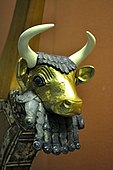
Bull's head from the Queen's Lyre from Pu-abi's grave, Ur, c. 2600 BC
-
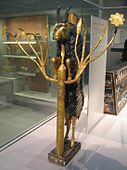
Ram in a Thicket; 2600–2400 BC; gold, copper, shell, lapis lazuli and limestone; height: 45.7 cm; from the Majestic Cemetery at Ur; British Museum
-
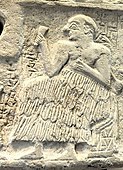
King Ur-Nanshe, seated, wearing flounced skirt. Limestone, Early Dynastic Three (2550–2500 BC). Plant in Telloh (ancient city of Girsu). Louvre Museum.[74] [75] [76]
-

Standard of Ur; 2600–2400 BC; shell, ruby limestone and lapis lazuli on wood; length: 49.five cm; from the Royal Cemetery at Ur; British Museum
-
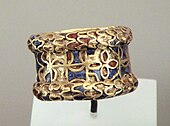
Ring of Gold, Carnelian, Lapis Lazuli, Tello, ancient Girsu, mid-3rd millennium BC.
-

Akkadian Empire period (c. 2271–2154 BC) [edit]

The Akkadian Empire was the starting time to control non but all Mesopotamia, only other territories in the Levant, from about 2271 to 2154 BC. The Akkadians were not Sumerian, and spoke a Semitic language. In art there was a peachy emphasis on the kings of the dynasty, aslope much that continued before Sumerian fine art. In big works and small ones such as seals, the degree of realism was considerably increased,[79] only the seals show a "grim world of cruel conflict, of danger and uncertainty, a world in which human being is subjected without appeal to the incomprehensible acts of distant and fearful divinities who he must serve just cannot love. This sombre mood ... remained feature of Mesopotamian art..."[fourscore]
Rex Naram-Sin'south famous Victory Stele depicts him equally a god-king (symbolized by his horned helmet) climbing a mountain to a higher place his soldiers, and his enemies, the defeated Lullubi. Although the stele was broken off at the top when it was stolen and carried off by the Elamite forces of Shutruk-Nakhunte, it withal strikingly reveals the pride, glory, and divinity of Naram-Sin. The stele seems to break from tradition by using successive diagonal tiers to communicate the story to viewers, however, the more traditional horizontal frames are visible on smaller broken pieces. It is six feet and seven inches tall, and made from pink sandstone.[81] [82] From the same reign, the bare legs and lower torso of the copper Bassetki Statue show an unprecedented level of realism, as does the imposing bronze head of a disguised ruler (Louvre).[83]
The Louvre head is a life-size, bronze bust institute in Nineveh. The intricate curling and patterning of the beard and the complex hairstyle suggests royalty, power, and wealth from an ideal male in society. Bated from its artful traits, this piece is spectacular because information technology is the primeval hollow-cast sculpture item known to use the lost-wax casting process.[84] There is deliberate damage on the left side of the face and eye, indicating that the bust was intentionally slashed at a later period to demonstrate political iconoclasm.[85]
-

-

Detail of a victory stele of Akkadian king Rimush
-
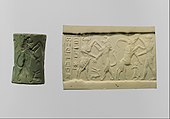
Cylinder seal and modern impression – balderdash-homo combatting lion; nude hero combatting water buffalo; 2250–2150 BC; albite; height: 3.4 cm, diameter: 2.3 cm; Metropolitan Museum of Art (New York Metropolis)
-

Naked captives, on the Nasiriyah stele of Naram-Sin.[87]
-

Goddess Ishtar on an Akkadian Empire seal, 2350–2150 BC. She is equipped with weapons in her back, has a horned helmet, and is trampling a lion.
Neo-Sumerian period (c. 2112–2004 BC) [edit]
After the fall of the Akkadian Empire, a local dynasty emerged in Lagash. Gudea, ruler of Lagash (reign ca. 2144 to 2124 BC), was a keen patron of new temples early in the period, and an unprecedented 26 statues of Gudea, mostly rather small-scale, have survived from temples, beautifully executed, mostly in "costly and very hard diorite" stone. These exude a confident serenity.[88]
The northern Imperial Palace of Mari produced a number of important objects from before about 1800 BC, including the Statue of Iddi-Ilum,[89] and the most extensive remains of Mesopotamian palace frescos.[90]
The Neo-Sumerian art of the Tertiary Dynasty of Ur reached new heights, peculiarly in terms of realism and fine craftmanship.
-

Statue of Gudea P; circa 2090 BC; diorite; height: 44 cm, width: 21.5 cm, depth: 29.v cm; Metropolitan Museum of Art
-

-
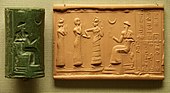
Seal of Hash-hamer, showing enthroned male monarch Ur-Nammu, with modern impression; circa 2100 BC; greenstone; height: 5.iii cm; British Museum (London)
Amorite and Kassite periods (c. 2000–1100 BC) [edit]
The political history of this flow of nearly 1000 years is complicated, marked past the rise of Semitic-speaking polities originating in northwestern Mesopotamia. The period includes the Amorites Isin-Larsa Period and the First Babylonian Dynasty or Former Babylonian period (c.1830–1531 BC), an interlude under the dominion of the Kassites (c. 1531–1155 BC) followed by invasions of the Elamite, while the Middle Assyrian Empire (1392–934 BC) developed in the northern part of Mesopotamia. The period ended with the decisive advent of the Neo-Assyrian Empire nether Adad-nirari Ii, whose reign began in 911 BC.
Isin-Larsa menstruation (c. 2000–1800 BC) [edit]
The Isin-Larsa menstruation is a period of turmoil, marked past the rising of the influence of the Amorites for the northwest of Mesopotamia. Life was often unstable, and non-Sumerian invasions a recurring theme.
-

Cylinder seal and modern impression. Presentation scene, c. 2000–1750 B.C. Isin-Larsa
-

King Iddin-Sin of the Kingdom of Simurrum, holding an axe and a bow, trampling a foe, in front of Goddess Ishtar. Circa 2000 BCE.
-

Four-faced god, Ishchali, Isin-Larsa to Old Babylonia periods, 2000–1600 BC, bronze - Oriental Found Museum, University of Chicago
Beginning Babylonian Dynasty (1830–1531 BC) [edit]
From the 18th century BC, Hammurabi (1792 BC to 1750 BC), the Amorite ruler of Babylon, turned Babylon into a major power and eventually conquered Mesopotamia and beyond. He is famous for his law code and conquests, but he is besides famous due to the large amount of records that exist from the menstruation of his reign. During the catamenia Babylon became a keen city, which was frequently the seat of the dominant power. The period was not ane of great artistic development, these invaders failing to bring new artistic impetus,[91] and much religious art was rather self-consciously conservative, perhaps in a deliberate exclamation of Sumerian values.[92] The quality of execution is often lower than in preceding and later periods.[93] Some "pop" works of art displayed realism and mouvement, such as the statuette of a walking iv-headed god from Ishchali, attributed to the period between 2000–1600 BC.[94]
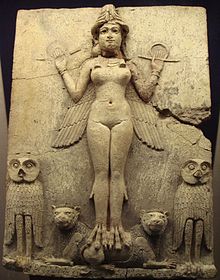
The Burney Relief is an unusual, elaborate, and relatively large (twenty×15 inches) terracotta plaque of a naked winged goddess with the feet of a bird of prey, and bellboy owls and lions. Information technology comes from the 18th or 19th centuries BC, and may also exist moulded. Similar pieces, pocket-sized statues or reliefs of deities, were made for altars in homes or pocket-size wayside shrines, and small moulded terracotta ones were probably available as souvenirs from temples.[95]
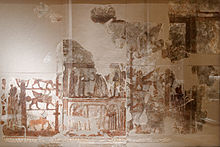
The Investiture of Zimri-Lim, now in the Louvre, is a large palace fresco that is the outstanding survival of Mesopotamian wall-painting, although comparable schemes were probably common in palaces.
After the death of Hammurabi, the first Babylonian dynasty lasted for another century and a one-half, but his empire apace unravelled, and Babylon one time more became a small state. The Amorite dynasty ended in 1595 BC, when Babylonia fell to the Hittite male monarch Mursilis, afterwards which the Kassites took command.
-

Detail of a limestone votive monument from Sippar, Iraq, dating to c. 1792 – c. 1750 BC showing Rex Hammurabi raising his right arm in worship, now held in the British Museum
-

Cylinder seal, ca. 18th–17th century BC. Babylonia
Kassites (1600–1155 BC) [edit]
The original homeland of the Kassites is not well-known, but appears to take been located in the Zagros Mountains, in what is now the Lorestan Province of Iran. This was generally not a period of the highest quality for cylinder seal images; at different times the inscription took prominence over the paradigm, and the variety of scenes shown reduced, with the "presentation scene" of a king before a god, or an official before a seated king, becoming the norm at times.[97] Especially from the Kassite menses several stone kudurru stelae survive, mostly taken up with inscriptions recording grants of country, boundary lines, and other official records, just often with figures and emblems of the gods or the king likewise; a country grant by Meli-Shipak II is an case.[98]
-

-

Cylinder seal of Kassite rex Kurigalzu II (c. 1332–1308 BC). Louvre Museum AOD 105
-
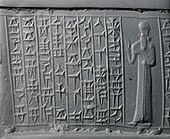
Kassite cylinder seal, ca. 16th–12th century BC.
Assyrian period (c. 1500 – 612 BC) [edit]

An Assyrian artistic manner distinct from that of Babylonian art, which was the dominant contemporary fine art in Mesopotamia, began to emerge c. 1500 BC, well before their empire included Sumer, and lasted until the autumn of Nineveh in 612 BC.
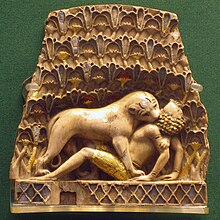
The conquest of the whole of Mesopotamia and much surrounding territory by the Neo-Assyrian Empire (911–609 BC) created a larger and wealthier state than the region had known before, and very grandiose art in palaces and public places, no incertitude partly intended to match the splendour of the art of the neighbouring Egyptian empire. From around 879 BC the Assyrians developed a style of extremely large schemes of very finely detailed narrative depression reliefs in stone or gypsum alabaster, originally painted, for palaces. The precisely delineated reliefs concern royal diplomacy, importantly hunting and war making. Predominance is given to animal forms, particularly horses and lions, which are magnificently represented in great detail.
Man figures are comparatively rigid and static merely are as well minutely detailed, as in triumphal scenes of sieges, battles, and individual combat. Among the best known Assyrian reliefs are the famous Panthera leo Hunt of Ashurbanipal scenes in alabaster, and the Lachish reliefs showing a war entrada in Palestine, both of which are of the 7th century BC, from Nineveh and now in the British Museum.[99] Reliefs were too carved into rock faces, as at Shikaft-eastward Gulgul, a style which the Persians continued.
The Assyrians produced relatively piffling sculpture in the round, with the fractional exception of colossal human-headed lamassu guardian figures, with the bodies of lions or bulls, which are sculpted in high relief on two sides of a rectangular cake, with the heads finer in the round (and ofttimes also five legs, then that both views seem complete). These marked fortified majestic gateways, an architectural grade common throughout Asia Pocket-size. A single statue of a nude female is known. The Assyrian class of the winged genie, winged spirits with bearded man heads seen in reliefs, influenced Ancient Greek art, which in its "orientalizing menses" added diverse winged mythological beasts including the Chimera, griffin and winged horses (Pegasus) and men (Talos).[100] Many carry the bucket and cone.
Even before dominating the region the Assyrians had continued the cylinder seal tradition with designs which are oftentimes uncommonly energetic and refined.[101] At Nimrud the carved Nimrud ivories and statuary bowls were found that are decorated in the Assyrian style simply were produced in several parts of the Near E including many by Phoenician and Aramaean artisans.
-
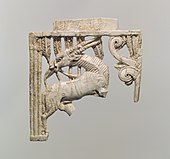
Openwork piece of furniture plaque with a grazing oryx in a forest of fronds; 9th–8th century BC; ivory; 12.7×11.91×i.09 cm; Metropolitan Museum of Art
-

Relief with two Assyrian cavalrymen charging against enemies; circa 728 BC; gypsum; height: 129 cm, width: 183; British Museum (London)
-

Cylinder seal with deities, one of them on a winged lion; 8th–7th century BC; quartz, crypto-crystalline; 4.09 cm; Metropolitan Museum of Fine art
-

Glazed terracotta tile from Nimrud, with a court scene, British Museum
-

Relief from Assyrian capital of Dur Sharrukin, showing send of Lebanese cedar; 716-713 BC; height: 2.41 m, width: 38 cm; Louvre
-
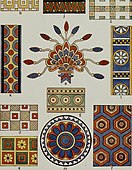
Assyrian ornaments and patterns, illustrated in a book from 1920
Neo-Babylonian period (626–539 BC) [edit]

The famous Ishtar Gate, part of which is now reconstructed in the Pergamon Museum in Berlin, was the master archway into Babylon, built in near 575 BC past Nebuchadnezzar II, the king of the Neo-Babylonian Empire, who exiled the Jews; the empire lasted from 626 BC to 539 BC. The walls surrounding the entrance way are decorated with rows of large relief animals in glazed brick, which has therefore retained its colours. Lions, dragons and bulls are represented. The gate was part of a much larger scheme for a processional way into the city, from which there are sections in many other museums.[102] Large wooden gates throughout the period were strengthened and decorated with large horizontal metal bands, often decorated with reliefs, several of which have survived, such as the diverse Balawat Gates.
Other traditional types of art continued to be produced, and the Neo-Babylonians were very cracking to stress their ancient heritage. Many sophisticated and finely carved seals survive. Afterward Mesopotamia fell to the Persian Achaemenid Empire, which had much simpler artistic traditions, Mesopotamian fine art was, with Ancient Greek art, the chief influence on the cosmopolitan Achaemenid style that emerged,[103] and many ancient elements were retained in the area even in the Hellenistic art that succeeded the conquest of the region by Alexander the Bang-up.
-

One of the mušḫuššu dragons from the Gate of Ishtar; 604–562 BC; glazed terra cotta, now Istanbul
Characteristics [edit]
1 fundamental intention of Mesopotamian art was to honour the gods and goddesses who ruled over different aspects of nature and of import life events. The fundamental identify of worship was the ziggurat, a stepped pyramid with stairs leading to an altar where worshipers would elevate themselves closer to the heavens. Much like the Egyptians, the Mesopotamians believed that their rulers had a direct link to their gods, and many artworks draw rulers shown in a glorified manner.
As in other ancient civilizations, the sculptures, mostly rather small, are the main type of artwork to survive. In the late catamenia Assyrian sculpture for palaces was often very large. Well-nigh of the Sumerian and Akkadian statues of figures are in a position of prayer. The chief types of stone used are limestone and alabaster.
Architecture [edit]
Aboriginal Mesopotamia is nigh noted for its structure of mud brick buildings and the construction of ziggurats, occupying a prominent place in each metropolis and consisting of an artificial mound, often rising in huge steps, surmounted by a temple. The mound was no doubtfulness to drag the temple to a commanding position in what was otherwise a apartment river valley. The swell urban center of Uruk had a number of religious precincts, containing many temples larger and more ambitious than any buildings previously known.[104]
The word ziggurat is an anglicized form of the Akkadian word ziqqurratum, the proper noun given to the solid stepped towers of mud brick. It derives from the verb zaqaru, ("to be loftier"). The buildings are described as beingness similar mountains linking World and heaven. The Ziggurat of Ur, excavated past Leonard Woolley, is 64 by 46 meters at base and originally some 12 meters in height with three stories. It was built under Ur-Nammu (circa 2100 B.C.) and rebuilt under Nabonidus (555–539 B.C.), when information technology was increased in height to probably 7 stories.[105]
Assyrian palaces had a large public courtroom with a suite of apartments on the east side and a series of large banqueting halls on the south side. This was to get the traditional plan of Assyrian palaces, built and adorned for the glorification of the king.[106] Massive amounts of ivory furniture pieces were establish in some palaces.


Jewellery [edit]

The preferred jewellery designs used in Mesopotamia were natural and geometric motifs such as leaves, cones, spirals, and bunches of grapes. Sumerian and Akkadian jewellery was created from golden and silver foliage and set with many semiprecious stones (mostly agate, carnelian, jasper, lapis lazuli and chalcedony). A number of documents have been found that relate to the merchandise and production of jewellery from Sumerian sites.
Later Mesopotamian jewellers and craftsmen employed metalworking techniques such as cloisonné, engraving, granulation, and grid. The big diversity and size of necklaces, bracelets, anklets, pendants, and pins constitute may be due to the fact that jewellery was worn past both men and women, and possibly even children.
-
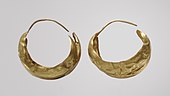
Pair of earrings; 2600–2500 BC; gold; Metropolitan Museum of Art
-

Necklace beads; 2600–2500 BC; gold and lapis lazuli; length: 54 cm; Metropolitan Museum of Art
-
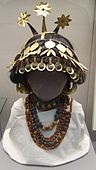
Sumerian necklaces and headgear discovered in the royal (and private) graves of the Majestic Cemetery at Ur, showing the mode they may have been worn, in British Museum (London)
Collections [edit]
-
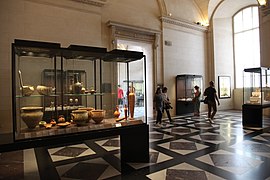
A room with Mesopotamian art, from the Louvre
Past some margin, the most important collections are those of (in no particular society) the Louvre Museum, the Vorderasiatisches Museum (Berlin, Frg), the British Museum (London), the Metropolitan Museum of Art (New York City), and the National Museum of Iraq (Baghdad). The final was extensively looted after the breakdown of police force and order following the 2003 invasion of Republic of iraq, but the nigh of import objects take largely been recovered.
Several other museums have good collections, especially of the very numerous cylinder seals. Syrian museums accept important collections from sites in modern Syria. Other museums with of import collections of Mesopotamian fine art are: the Oriental Institute of Chicago, İstanbul Archaeology Museums (Istanbul, Turkey), Academy of Pennsylvania Museum of Archaeology and Anthropology, Rijksmuseum van Oudheden (Leiden, the Netherlands) and the Israel Museum (Jerusalem). The reconstructed Ishtar Gate in Pergamon Museum (Berlin) is arguably the virtually spectacular single work in a museum.
See too [edit]
- Iraqi art
- Architecture of Mesopotamia
- Ancient Mesopotamian faith
Notes [edit]
- ^ Frankfort, 124-126
- ^ Frankfort, Chapters two–five
- ^ Convenient summaries of the typical motifs of cylinder seals in the primary periods are found throughout in Teissier
- ^ Frankfort, 66–74
- ^ Frankfort, 71–73
- ^ Frankfort, 66–74; 167
- ^ Murray, Tim (2007). Milestones in Archaeology: A Chronological Encyclopedia. ABC-CLIO. p. 454. ISBN9781576071861.
- ^ Edwards, Owen (March 2010). "The Skeletons of Shanidar Cave". Smithsonian . Retrieved 17 October 2014.
- ^ Yiśraʼel (Jerusalem), Muzeʼon; Museum (Jerusalem), Israel (1986). Treasures of the Holy Land: Aboriginal Art from the State of israel Museum. Metropolitan Museum of Art. p. 29. ISBN9780870994708.
- ^ "Horse from Hayonim Cave, Israel, xxx,000 years" in State of israel Museum Studies in Archaeology. Samuel Bronfman Biblical and Archaeological Museum of the Israel Museum. 2002. p. 10.
- ^ "Hayonim equus caballus". museums.gov.il.
- ^ Bar-Yosef, Ofer; Belfer-Cohen, Anna (1981). The Aurignacian at Hayonim Cave. pp. 35–36.
- ^ a b Chacon, Richard J.; Mendoza, Rubén 1000. (2017). Feast, Famine or Fighting?: Multiple Pathways to Social Complexity. Springer. p. 120. ISBN9783319484020.
- ^ a b Schmidt, Klaus (2015). Premier temple. Göbekli tepe (Le): Göbelki Tepe (in French). CNRS Editions. p. 291. ISBN9782271081872.
- ^ a b Collins, Andrew (2014). Gobekli Tepe: Genesis of the Gods: The Temple of the Watchers and the Discovery of Eden. Simon and Schuster. p. 66. ISBN9781591438359.
- ^ Sagona, Claudia (2015-08-25). The Archæology of Malta. Cambridge University Press. p. 47. ISBN9781107006690 . Retrieved 25 Nov 2016.
- ^ "The Earliest Uses of Dirt in Syria | Expedition Magazine". www.penn.museum.
- ^ Kuijt, Ian (2006). Life in Neolithic Farming Communities: Social Organization, Identity, and Differentiation. Springer Science & Business Media. p. 238. ISBN9780306471667.
- ^ Otte, Marcel (2008). La protohistoire (in French). De Boeck Supérieur. p. 35. ISBN9782804159238.
- ^ "Metropolitan Museum of Art". www.metmuseum.org.
- ^ a b Maisels, Charles Keith (2003). The Emergence of Civilisation: From Hunting and Gathering to Agriculture, Cities and the State of the Near East. Routledge. pp. 104–105. ISBN9781134863280.
- ^ Pirajno, Franco; Ünlü, Taner; Dönmez, Cahit; Şahin, K. Bahadır (2019). Mineral Resources of Turkey. Springer. p. eight. ISBN9783030029500.
- ^ Moorey, Peter Roger Stuart (1999). Ancient Mesopotamian Materials and Industries: The Archaeological Evidence. Eisenbrauns. p. 39. ISBN9781575060422.
- ^ "Site officiel du musée du Louvre". cartelfr.louvre.fr.
- ^ For Jarmo pottery photograph, see "A Dish from the Jarmo Civilization". Earth History Encyclopedia.
- ^ a b Brownish, Brian A.; Feldman, Marian H. (2013). Critical Approaches to Ancient Near Eastern Art. Walter de Gruyter. p. 304. ISBN9781614510352.
- ^ "Site officiel du musée du Louvre". cartelfr.louvre.fr.
- ^ Carter, Robert A. and Philip, Graham Beyond the Ubaid: Transformation and Integration in the Late Prehistoric Societies of the Middle E (Studies in Ancient Oriental Civilization, Number 63) The Oriental Institute of the Academy of Chicago (2010) ISBN 978-i-885923-66-0 p. 2; "Radiometric data suggest that the whole Southern Mesopotamian Ubaid catamenia, including Ubaid 0 and v, is of immense duration, spanning almost three millennia from about 6500 to 3800 B.C."
- ^ Hall, Henry R. and Woolley, C. Leonard. 1927. Al-'Ubaid. Ur Excavations ane. Oxford: Oxford University Press.
- ^ Adams, Robert MCC. and Wright, Henry T. 1989. 'Concluding Remarks' in Henrickson, Elizabeth and Thuesen, Ingolf (eds.) Upon This Foundation - The 'Ubaid Reconsidered. Copenhagen: Museum Tusculanum Printing. pp. 451–456.
- ^ a b Carter, Robert A. and Philip, Graham. 2010. 'Deconstructing the Ubaid' in Carter, Robert A. and Philip, Graham (eds.) Beyond the Ubaid: Transformation and Integration in the Late Prehistoric Societies of the Middle East. Chicago: The Oriental Constitute of the Academy of Chicago. p. ii.
- ^ Susan Pollock; Reinhard Bernbeck (2009). Archaeologies of the Centre East: Critical Perspectives. p. 190. ISBN9781405137232.
- ^ Jr, William H. Stiebing (2016). Ancient Near Eastern History and Civilisation. Routledge. p. 85. ISBN9781315511160.
- ^ a b "Site officiel du musée du Louvre". cartelfr.louvre.fr.
- ^ Brown, Brian A.; Feldman, Marian H. (2013). Critical Approaches to Ancient Well-nigh Eastern Art. Walter de Gruyter. p. 304. ISBN9781614510352.
- ^ Charvát, Petr (2003). Mesopotamia Earlier History. Routledge. p. 96. ISBN9781134530779.
- ^ "Site officiel du musée du Louvre". cartelfr.louvre.fr.
- ^ The Looting Of The Republic of iraq Museum Baghdad The Lost Legacy Of Ancient Mesopotamia. 2005. p. Chapter Three.
- ^ Crawford 2004, p. 69
- ^ Crawford 2004, p. 75
- ^ Frankfort, 27
- ^ Frankfort, 241-242
- ^ Frankfort, 24, 242
- ^ Frankfort, 24-28, 31-32
- ^ Stokstad, Marilyn (2018). Fine art History. Upper Saddle River: Pearson. pp. 29–30, 33. ISBN9780134479279.
- ^ Frankfort, 32-33
- ^ Frankfort, 28-37
- ^ Frankfort, 36-39
- ^ Art of the first cities : the third millennium B.C. from the Mediterranean to the Indus. p. 25.
- ^ The Looting Of The Iraq Museum Baghdad The Lost Legacy Of Ancient Mesopotamia. 2005. p. eight.
- ^ Kleiner, Fred S.; Mamiya, Christin J. (2006). Gardner's Fine art Through the Ages: The Western Perspective – Volume ane (twelfth ed.). Belmont, California, USA: Thomson Wadsworth. pp. 20–21. ISBN0-495-00479-0.
- ^ Fine art of the First Cities: The Third Millennium B.C. from the Mediterranean to the Indus . Metropolitan Museum of Fine art. 2003. p. 481. ISBN9781588390431.
- ^ "Vorderasiatisches Museum Berlin". repository.edition-topoi.org.
- ^ "Vorderasiatisches Museum Berlin". repository.edition-topoi.org.
- ^ "Site officiel du musée du Louvre". cartelfr.louvre.fr.
- ^ "Site officiel du musée du Louvre". cartelfr.louvre.fr.
- ^ Cooper, Jerrol S. (1996). The Study of the Aboriginal Near E in the Twenty-first Century: The William Foxwell Albright Centennial Conference. Eisenbrauns. pp. 10–14. ISBN9780931464966.
- ^ Hartwig, Melinda K. (2014). A Companion to Ancient Egyptian Art. John Wiley & Sons. pp. 424–425. ISBN9781444333503.
- ^ Shaw, Ian. & Nicholson, Paul, The Dictionary of Ancient Egypt, (London: British Museum Printing, 1995), p. 109.
- ^ a b Mitchell, Larkin. "Earliest Egyptian Glyphs". Archaeology. Archaeological Found of America. Retrieved 29 February 2012.
- ^ Hartwig, Melinda K. (2014). A Companion to Ancient Egyptian Art. John Wiley & Sons. p. 427. ISBN9781444333503.
- ^ Conference, William Foxwell Albright Centennial (1996). The Study of the Ancient Near East in the Twenty-first Century: The William Foxwell Albright Centennial Conference. Eisenbrauns. p. fourteen. ISBN9780931464966.
- ^ Demand, Nancy H. (2011). The Mediterranean Context of Early Greek History. John Wiley & Sons. p. 69. ISBN9781444342345.
- ^ Collon, Dominique (1995). Ancient Nigh Eastern Art. Academy of California Press. pp. 51–53. ISBN9780520203075.
- ^ a b Crawford, Harriet (2013). The Sumerian World. Routledge. pp. 703–705. ISBN978-1-136-21911-5.
- ^ Breniquet, Catherine (2016). "Que savons-nous exactement du kaunakès mésopotamien?". Revue d'assyriologie et d'archéologie orientale. 110 (January): ane–22. doi:10.3917/assy.110.0001.
- ^ Art of the Get-go Cities: The Third Millennium B.C. from the Mediterranean to the Indus. Metropolitan Museum of Art. 2003. pp. 64–65. ISBN978-i-58839-043-ane.
- ^ Frankfort, 55
- ^ Frankfort, 60–61
- ^ Frankfort, 61–66
- ^ Frankfort, 71-76
- ^ Frankfort, 46-49; the group are now divided between the Metropolitan Museum, New York, Oriental Institute, Chicago, and the National Museum of Republic of iraq (with the god).
- ^ Frankfort, 55-60, 55 quoted
- ^ Lourve Pouysségur, Patrick , ed. "Perforated Relief of King Ur-Nanshe." Louvre Museum. Louvre Museum. Spider web. 13 Mar 2013..
- ^ Transliteration: "CDLI-Found Texts". cdli.ucla.edu.
- ^ Similar text: "CDLI-Found Texts". cdli.ucla.edu.
- ^ Spycket, Agnès (1981). Handbuch der Orientalistik (in French). BRILL. p. 87–89. ISBN978-ninety-04-06248-i.
- ^ Parrot, André (1953). "Les fouilles de Mari Huitième campagne (automne 1952)". Syria. xxx (iii/4): 196–221. doi:ten.3406/syria.1953.4901. ISSN 0039-7946. JSTOR 4196708.
- ^ Frankfort, 83–91
- ^ Frankfort, 91
- ^ Kleiner, Fred (2005). Gardner'southward Fine art Through The Ages. Thomson-Wadsworth. p. 41. ISBN0-534-64095-8.
- ^ Frankfort, 86
- ^ Frankfort, 91
- ^ Stokstad, Marilyn (2018). Art History. Upper Saddle River: Pearson. p. 36. ISBN9780134479279.
- ^ Nylander, Carl (July 1980). "Earless in Nineveh: Who Mutilated 'Sargon's' Head?". American Journal of Archeology. 84 (3): 329–333. doi:10.2307/504709. JSTOR 504709.
- ^ M. E. 50. Mallowan, "The Statuary Caput of the Akkadian Period from Nineveh", Iraq Vol. 3, No. ane (1936), 104–110.
- ^ McKeon, John F. Ten. (1970). "An Akkadian Victory Stele". Boston Museum Bulletin. 68 (354): 239. ISSN 0006-7997. JSTOR 4171539.
- ^ Frankfort, 93 (quoted)-99
- ^ Frankfort, 114–119
- ^ Frankfort, 124-126
- ^ Frankfort, 127
- ^ Frankfort, 93
- ^ Frankfort, 110-116, 126
- ^ Roux, Georges (1992). Ancient Iraq. Penguin Books Express. p. 204. ISBN9780141938257.
- ^ Frankfort, 110–112
- ^ Roux, Georges (1992-08-27), "The Fourth dimension of Defoliation", Ancient Republic of iraq, Penguin Books, p. 266, ISBN9780141938257
- ^ Frankfort, 102-126
- ^ Frankfort, 130
- ^ Frankfort, 141–193
- ^ Frankfort, 205
- ^ Frankfort, 141–193
- ^ Frankfort, 203–205
- ^ Frankfort, 348-349
- ^ Risebero, Bill (2018). The Story of Western Compages. Bloomsbury. p. 13. ISBN978-1-3500-9212-9.
- ^ "Gods and Goddesses". Mesopotamia.co.united kingdom . Retrieved 9 November 2015.
- ^ Cole, Emily (2002). Architectural Details. Ivy Press. p. 32. ISBN978-1-78240-169-eight.
References [edit]
- Crawford, Harriet E. W. (16 Sep 2004). Sumer and the Sumerians (2nd ed.). Cambridge University Press. ISBN9780521533386.
- Frankfort, Henri, The Art and Architecture of the Aboriginal Orient, Pelican History of Art, 4th ed 1970, Penguin (now Yale History of Art), ISBN 0140561072
- Teissier, Beatrice, Ancient Most Eastern Cylinder Seals from the Marcopolic Collection, 1984, University of California Press, ISBN 0520049276, 9780520049277, google books
Farther reading [edit]
- Crawford, Vaughn E.; et al. (1980). Assyrian reliefs and ivories in the Metropolitan Museum of Fine art: palace reliefs of Assurnasirpal 2 and ivory carvings from Nimrud. New York: The Metropolitan Museum of Fine art. ISBN0870992600.
Source: https://en.wikipedia.org/wiki/Art_of_Mesopotamia
0 Response to "What Three Elements or Principles Are in the Art Piece a Mesopotamian Votive Dog Statuette"
Post a Comment