App Similar to Discord With Higher Audio Quality and Upload Size
Comparison Slack to Discord doesn't, at first glance, make sense. Information technology's apples to oranges—or, more accurately, conference room to arcade—in terms of branding. I hateful, look at the homepages:
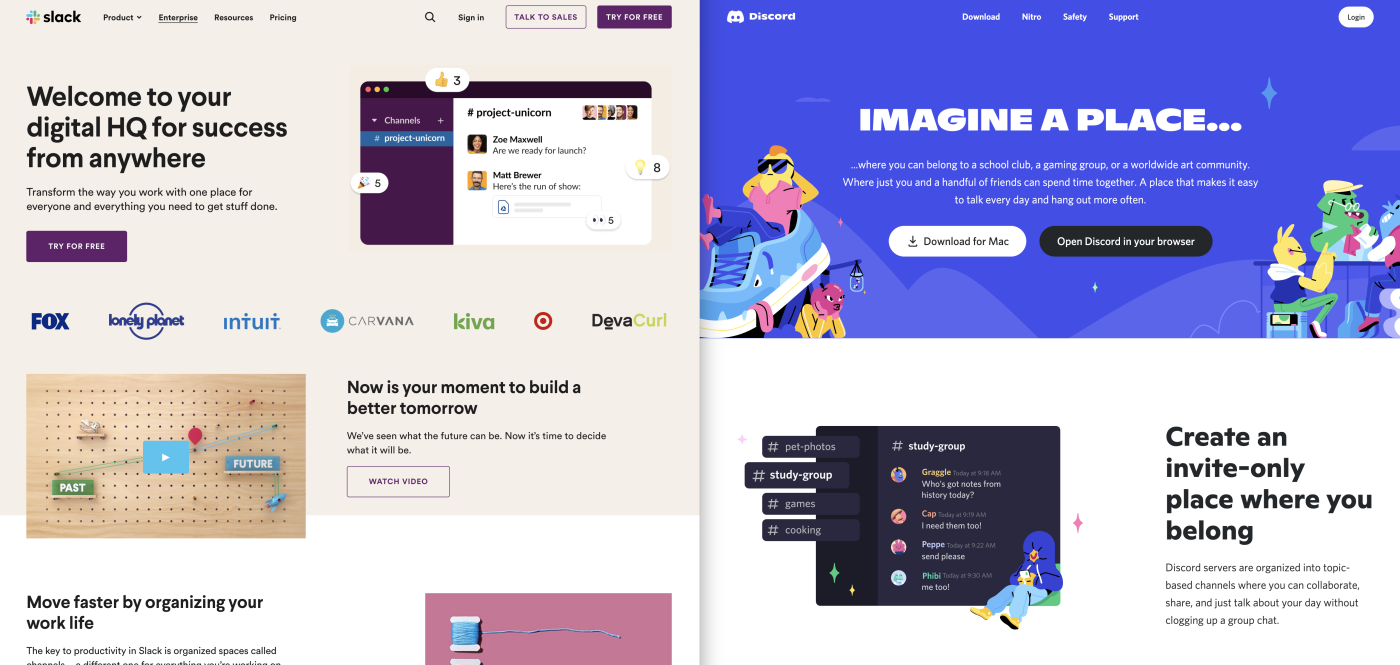
Slack is all-in on business. Discord, historically branded as a gaming tool, these days aims to serve online communities more generally. Non exactly overlapping categories, right? Pare away the branding, though, and these two apps aren't and then different. They even wait similar on the within.
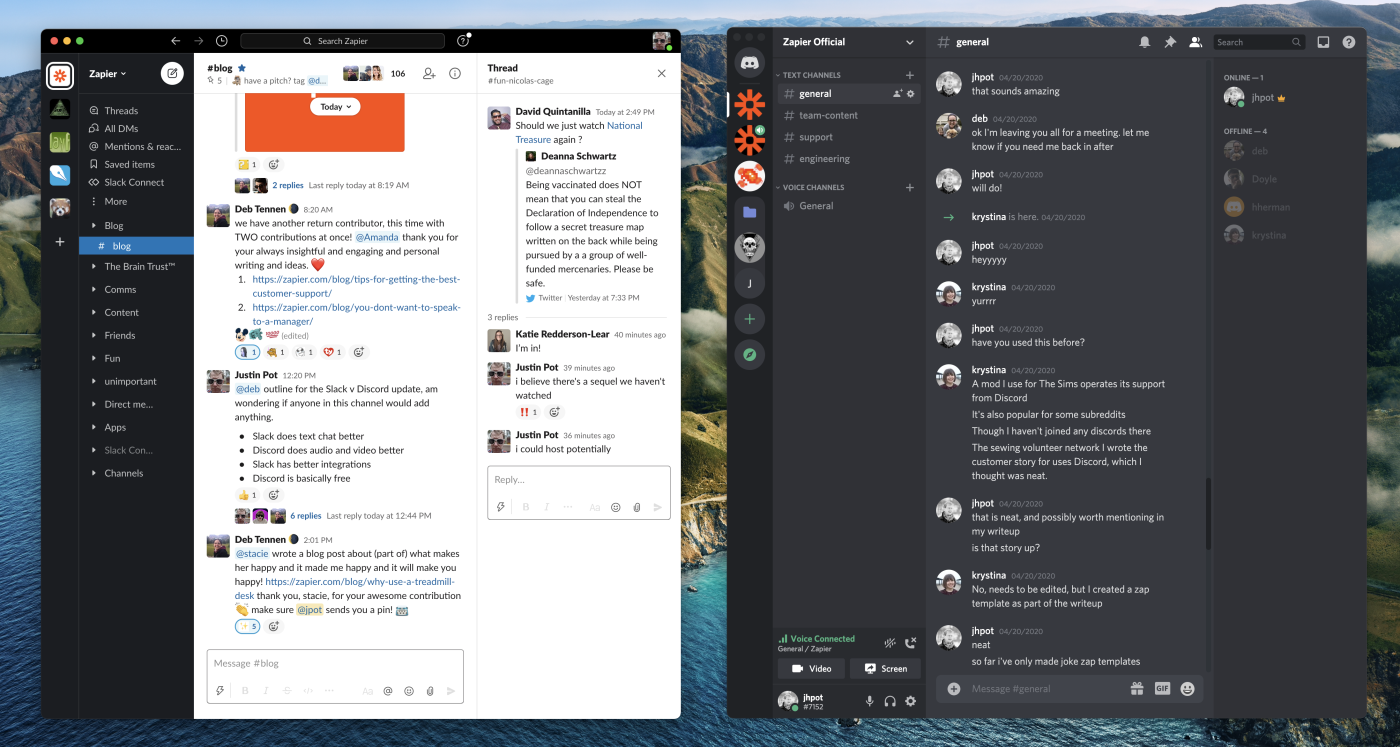
Both take a left sidebar full of icons, depending on which group of people you desire to talk to. Beside that is a listing of channels, then the current conversation, and a right sidebar. It's uncanny.
The similarities continue. Both offer teams the chance to prepare multiple channels for text conversation. Both offer video and sound calls. And both are used by millions of people every day, which is part of why they both made our list of the all-time team chat apps.
Use automation to back up brainstorming, delegation, and communication
So, I understand why people might think these apps are interchangeable—to an extent, they are. There are plenty of online communities that happen on Slack, and some people apply Discord for business organization. There is overlap.
Merely these apps aren't interchangeable. They have dissimilar strengths and weaknesses, which reflects their designers' priorities. Let'southward pause those downwards and talk about what makes sense to utilise in which contexts.
Slack does text chat better, especially for work
Text conversation seems simple enough. You type something, you press enter, then your team can see it. And that's truthful, but put a agglomeration of people in a chat room, and things get disorganized quickly. Both Slack and Discord clearly have this in listen, but Slack seems just a bit more than focused on keeping things organized—peculiarly if y'all're working on a large team.
Discord has been catching up on this lately—adding threads is a big pace. But there are still a lot of piddling quality-of-life things that Slack does just a little bit ameliorate.
-
Slack lets users privately salvage posts for future reference; Discord doesn't.
-
Slack offers a Mentions & reactions view, allowing you to come across spots you've been mentioned and emoji reactions to your posts in one place; Discord doesn't.
-
Slack lets y'all organize your sidebar using folders; Discord doesn't.
And information technology'southward not only text—this extends to other features. Discord users can't upload files larger than eight megabytes (MB) on the costless version (or 50MB if they're paid users). Slack's complimentary version limits users to 5 gigabytes (GB) of costless storage overall, with no limit on private file size. Slack, in this way, works better for rapidly sharing files.
I could keep. Slack has all kinds of fiddling chat touches that Discord lacks. One of my most read articles is virtually how to bold on Discord because Discord doesn't do annihilation to help people larn how its formatting works. Slack has obvious formatting buttons. There's just more attention to detail on Slack when it comes to text chat.
This isn't to say that Discord is unusable. Slack just has more polish, and that gives it an edge in this category.
Discord does audio and video ameliorate
Slack offers video chat. A lot of their customers pay for Zoom. How much more do I actually need to say? Audio and video calls simply aren't one of Slack'south strengths.
Discord, however, excels on the AV front. Audio channels are what Discord built its reputation around. Gamers left the service running in the background on their computers, then they could talk to each other while playing online games. It's important for audio chats to have very footling lag in that context, and Discord delivers—Slack, meanwhile, is lacking on that front. Discord's audio quality is also much improve, and there are all kinds of options Slack lacks. Yous can adapt the volume for anybody in the conversation, for case.
Until recently, there was a different philosophy here, but the two apps are converging. Discord offers dedicated audio channels, which users tin plow on and off whenever they want. It's less similar a telephone call and more than like a room you stop by in. This is perfect for gaming and general hanging out, but information technology's as well a great co-working tool. People can end by and leave as they like, and there'southward even video and screen sharing. Slack recently launched a new characteristic called Huddles that'south very similar to Discord'south ever-on audio channels and can largely exist used the same style.
Both services too offer something more similar traditional phone calls, with video and screen sharing. In my tests, Slack works a lot less reliably, which is probably why so many of our customers connect Slack to Zoom.
Slack has ameliorate integrations (simply you lot tin work around that)
Slack offers thousands of integrations with all kinds of business applications, from Google Drive to Zoom to Twitter. Discord doesn't really offering official integrations, relying instead on bots built by third parties. These tend to be focused less on getting work washed and more on edifice communities, which over again makes sense given each app's target market. Simply if yous rely on native integrations with SaaS apps, Discord probably isn't the best fit.
In that location are workarounds, though. You tin build a Discord bot using Zapier, for example. Or y'all tin use Zapier to connect Discord to any of the other apps you lot use, allowing y'all to build just almost whatsoever Discord integration you can imagine. Y'all could, for example, find out when there are new posts on a Twitter page or RSS feed or when a new YouTube video is posted. But you could also create more than work-related workflows, like alerting you when a coming together is about to start or when a new task has been added to your project management tool.
There's too nothing stopping y'all from building your ain Slackbot, while y'all're at it.
Companies have more command over Slack
Slack is built with workplace administrators in mind, who own the workspace and enforce their ain rules. The company owns the Slack, basically.
Discord is closer to a public website, like Reddit. It's built with customs moderators in mind, and there are Discord-wide content policies and enforcement. Put simply, companies running a Slack are in control. Discord moderators aren't—at least, non to the same extent.
This extends to how direct letters (DMs) piece of work. Slack DMs occur inside a specific Slack instance, even if you lot're messaging someone outside your organization. The company that owns your Slack case potentially has access to those DM records. Discord DMs are system-wide, not unique to a particular server, meaning a business concern that uses Discord is much less in control, and has a worse legal case for DM access.
This makes sense, given the departure in target market and philosophy. Information technology's just worth keeping in listen.
Discord is basically free, while Slack's gratuitous version is limited
Pricing is another example of Discord being community-minded and Slack being focused on organizations.
Running a Discord server is free and comes with basically all features. Private users tin pay for Nitro and unlock a few goodies, like more than custom emoji and bigger upload sizes. Individual users tin can also opt to give boosts to servers, which unlocks more than emoji slots and animated server icons. Information technology'south very much on community members to donate these perks, if they want to, and the differences are largely cosmetic.
Slack couldn't be more different. The free version lacks many primal features. Near notably, the message archive is limited to the almost recent 10,000 messages. There's no mode for an private user to upgrade—the admin has to pay, and the price is per user. Standard, the cheapest tier, is $8 per user per month. That adds up quickly, peculiarly for an online community. This kind of pricing is probably only sustainable for businesses.
Slack or Discord: Which should you lot utilise?
Given these differences, which service should y'all use? Honestly, I call back you should trust the branding (and this is coming from someone who does non, every bit a rule, trust branding). Discord is ideal for online communities, while Slack is ameliorate for businesses. It's just what they're built for.
This isn't to say you lot tin can't mix it upward. You lot can admittedly host an online community on Slack, particularly if you're fine with merely having an annal of the 10,000 about recent messages. And you lot can use Discord for business organisation, if you're willing to work around some of the limitations. These tools aren't interchangeable, exactly, but they take plenty similarities that you have a choice to make. Just keep the differences in listen.
This commodity was originally published in June 2019 past Dane O'Leary.
Get productivity tips delivered directly to your inbox
We'll e-mail you one-3 times per week—and never share your information.
Source: https://zapier.com/blog/slack-vs-discord/
0 Response to "App Similar to Discord With Higher Audio Quality and Upload Size"
Post a Comment